The Ultimate Guide to Mt. Aso: Driving vs. Public Transport (And Why You Should Drive)
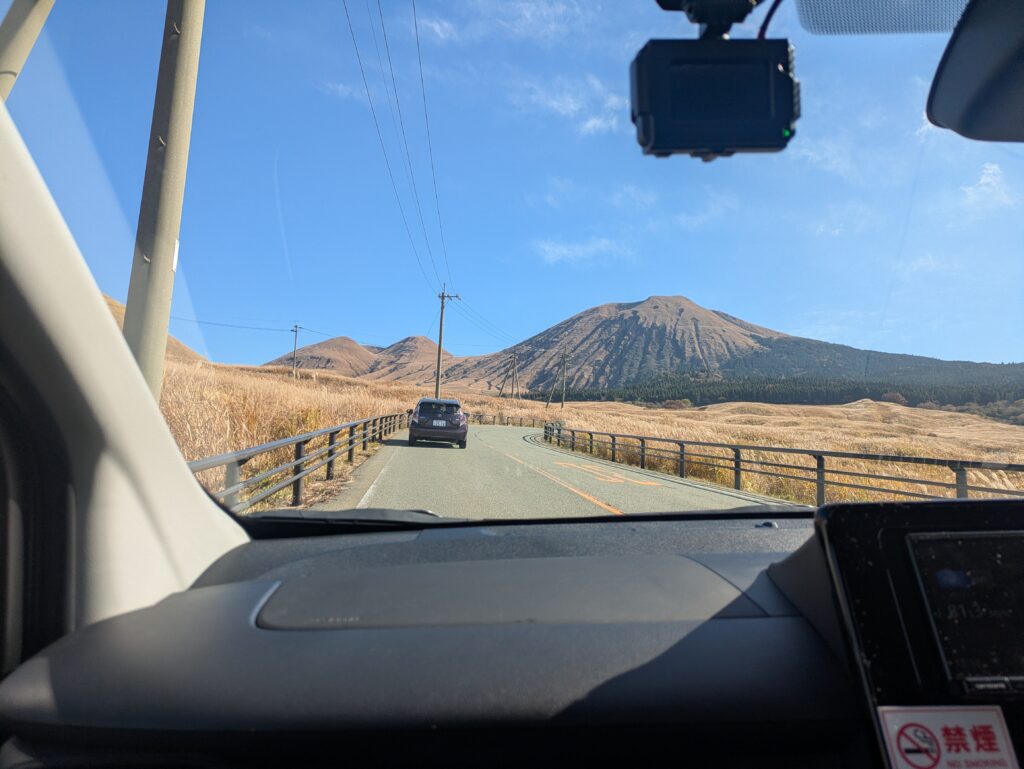
When I first started researching my trip to Kyushu, Mt. Aso was one of the first destinations that caught my eye—and now that I’ve experienced it first hand, I completely understand why. While it might not feature on any “hidden gem” lists, its popularity isn’t born from a viral reel or an influencer’s fleeting recommendation. Mt. Aso exists in a world of its own. Driving through the rolling green hills (which turn a striking golden yellow in autumn) with not a single man-made building in sight, you realize you are nowhere near the Japan you expected. In fact, it barely feels like you’re on this planet at all.
Getting to Mt. Aso: Driving vs. Public Transport
Whether you are using Fukuoka as your gateway to Kyushu or basing yourself closer in Kumamoto, you have two main ways to reach the caldera. We started our own journey to Aso from Kumamoto, and it was a remarkably easy drive. Because we didn’t have to rush, we managed to get up the mountain well before most people arrived, meaning we had most of the landscape completely to ourselves.
Option 1: Renting a Car (Highly Recommended)
If the idea of driving on mountain roads in a foreign country makes you nervous, let me reassure you: driving in regional Japan is incredibly peaceful.
Unlike the fast, aggressive traffic you might be used to back home, the speed limits here are much slower. Once you get out into the Aso region the roads are beautifully maintained in most places, and blissfully quiet (unless you choose to go right on peak tourist time, which is on you!). In typical Japanese fashion, local drivers are immensely patient and respectful, meaning you can take your time without feeling rushed.
Having your own car means you are fully immersed in the scenery. Half the wonder of Mt. Aso is the drive itself—winding through massive, rolling green ridges and sudden volcanic drop-offs without a single man-made building in sight. Plus, it gives you the freedom to arrive before the tour buses.
- From Kumamoto: A straightforward, scenic 60 to 90-minute drive (about 45 km). Basing yourself here lets you hit the road early and reach the crater before the crowds.
- From Fukuoka: Takes about 2 to 2.5 hours via the Kyushu Expressway before winding up into the mountains.
Option 2: Trains and Buses (Public Transport)
If you prefer not to drive, you can absolutely make it work using public transport, but you will be tied to a sparse, rigid timetable.
Step 1: Get to Aso Station
- From Fukuoka: Take the Shinkansen from Hakata Station to Kumamoto Station (30–40 minutes). From there, switch to the local JR Hohi Line.
- From Kumamoto: Take the JR Hohi Line directly to Aso Station. Local trains take around 100 minutes, while direct Limited Express trains take about 70 minutes.
- Tip: Look into the Aso Boy! limited express train. It’s a dedicated, panoramic sightseeing train that makes the transit feel like a proper experience.
Step 2: The Mountain Ascent The trains only get you to Aso Station at the base of the mountain. From there, you must catch the Sanko Bus (Aso-Sanjo Line) up to the Kusasenri Plateau and the crater rim. It’s a 35-minute ride, but it only runs a few times a day, so you will need to map out your return schedule carefully.
Option 3: Guided Day Tours (The Stress-Free Choice)
If you don’t want to drive but still want to avoid the headache of matching up train and bus timetables, booking a day tour through Klook is a fantastic alternative. It lets you sit back and relax while someone else handles the mountain roads.
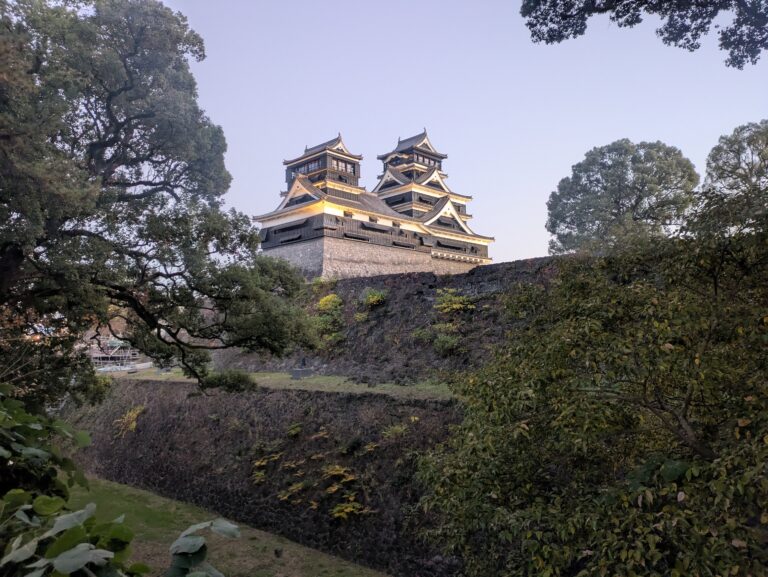
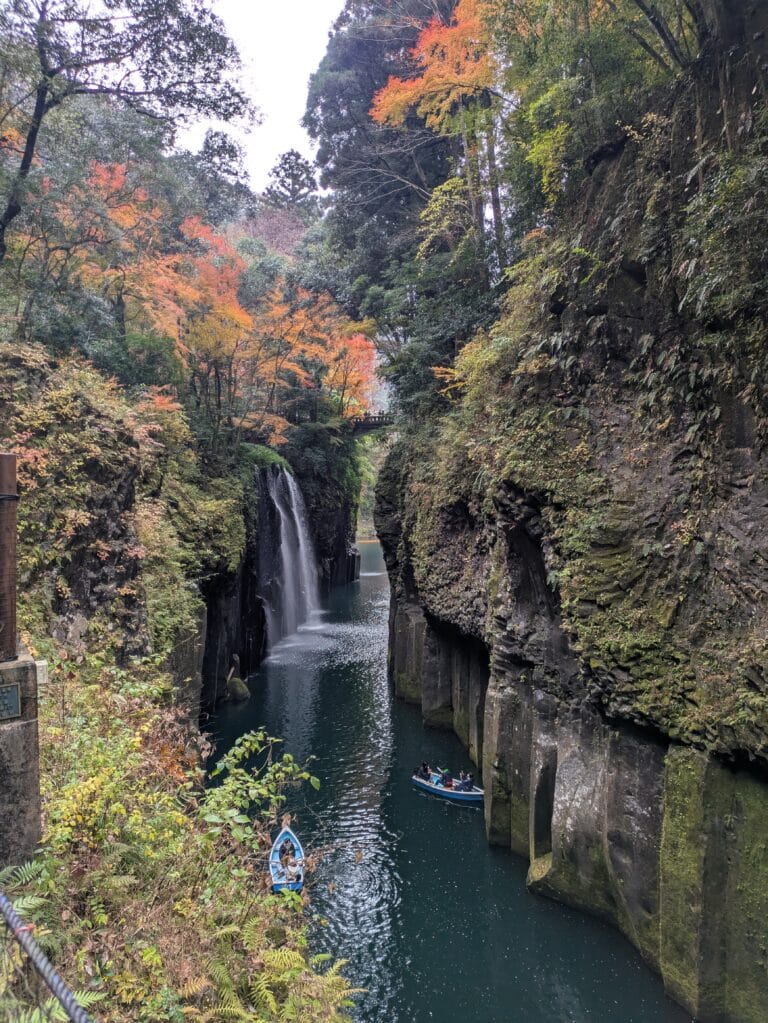
There are multiple options available depending on your travel style—some are simple transport-only shuttle buses, while others include a dedicated tour guide. Because Mt. Aso is deep in the heart of Kyushu, these day trips are usually packaged as full-day itineraries. Depending on the tour you pick, they often combine a visit to the volcano with other iconic nearby attractions, such as Kumamoto Castle or the breathtaking Takachiho Gorge.
While a combined tour is a good option if you are severely short on time, I wouldn’t actually recommend trying to do both Mt. Aso and Takachiho Gorge in a single day. They are both massive, spectacular destinations that deserve their own dedicated days to truly appreciate—which is exactly why renting a car and pacing yourself wins every time.
However, if a day tour is your best fit, I suggest checking out this One-Day Kyushu Tour on Klook. It includes a shuttle bus and an English-speaking guide departing from either Fukuoka or Kumamoto, taking you not only to Mount Aso but also to the mystical Kamishikimi Kumanoza Shrine and the beautiful Kurokawa Onsen.
Stopping at Kusasenri Plateau (Kusasenri-ga-hama)
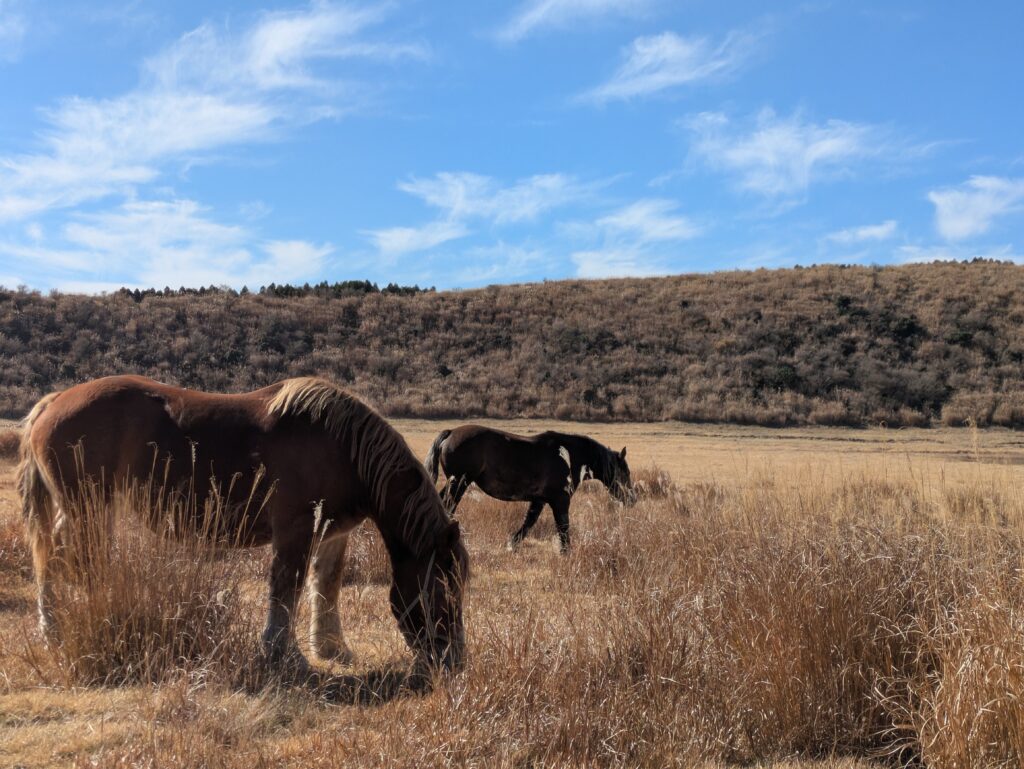
Before you reach the steaming lip of the main crater, the mountain landscape suddenly breaks open into a sweeping, silent basin. Complete with its own free-roaming horses with the expansive rolling hills in the background, it looks like you just stepped into a fantasy novel.
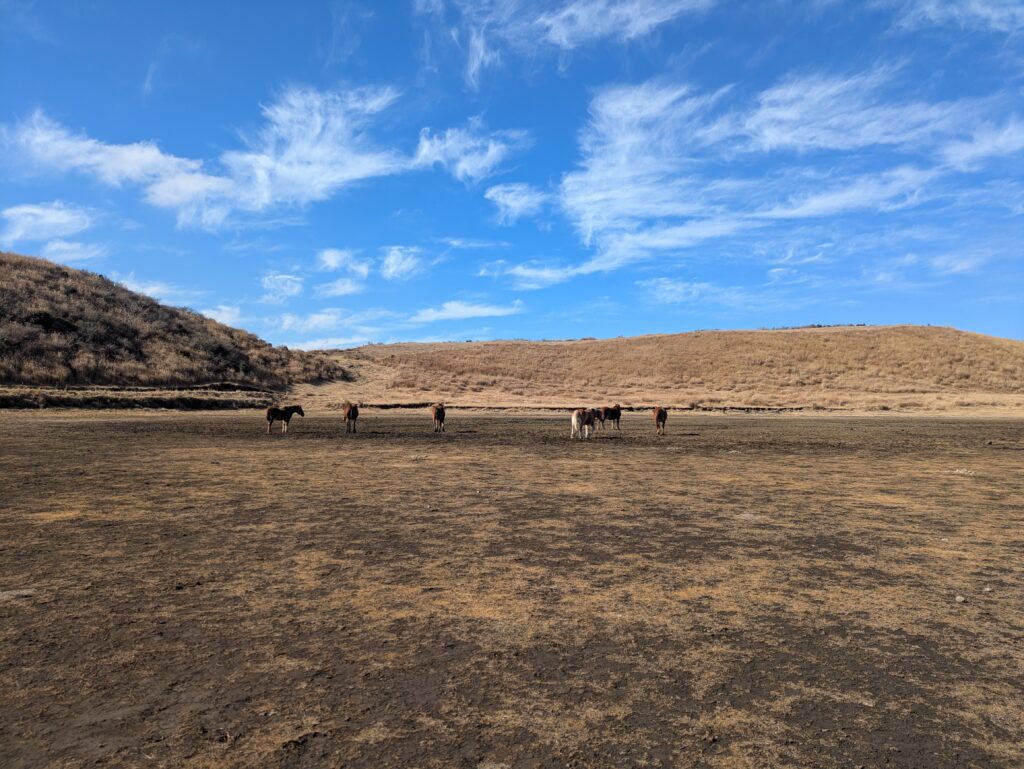
The Kusasenri Plateau is a massive, double-crater meadow sitting right under the smoking silhouette of Nakadake. It is a vast expanse of plains dotted with two large rain-fed ponds. We visited during autumn, and I absolutely loved the look of the golden grass washing over the rolling hills—though seeing the entire landscape blanketed in its vibrant summer green is already high on my list for a return trip.
Whether you are using it as your main base while the summit is closed, or stopping by for a great lunch spot before or after heading up the mountain when the crater is open, it makes the perfect place to pull over and stretch your legs.
The Plateau Horses
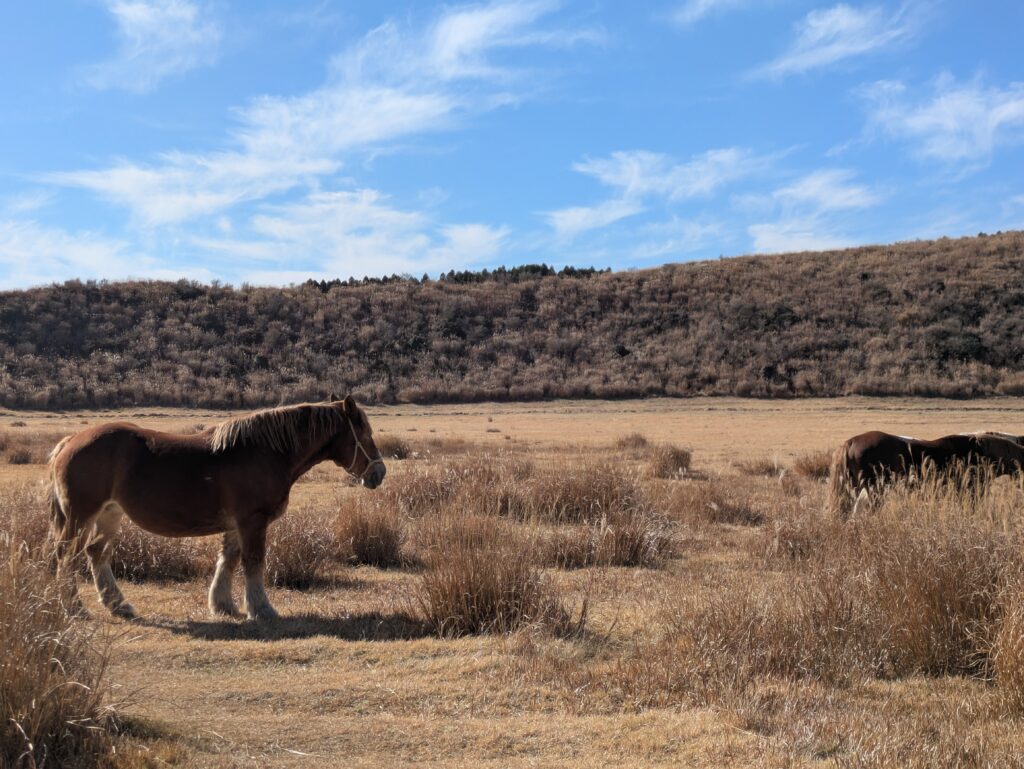
If you visit between March and December, you will see horses roaming across the wide-open plains against the backdrop of the smoking volcano. I’m not even a massive horse lover myself, but standing out there sharing the landscape with them felt incredibly surreal.
While there are fences near the main paths and parking lot to keep a safe distance, once you head down into the basin itself, the horses are released entirely fence-free to graze, wander down to the rain-fed ponds, and nap on the grassland as they please. The sheer scale of the landscape makes them look tiny against the mountains, adding a quiet, peaceful energy to the entire plateau. If you want to experience the scenery from a different perspective, you can book a short, guided horseback ride right from the edge of the plains. But even if you just sit back and watch them move across the basin with the steam rising in the distance, it’s easily one of the most unforgettable highlights of the entire trip.
Lunch with a View: New Kusasenri
For lunch, head to the New Kusasenri restaurant and cafe hub at the main parking area. It has large floor-to-ceiling windows looking directly out over the plains.
This is the spot to try local Kumamoto specialties, specifically Akaushi beef bowls (a premium, lean wagyu brown cattle local to this area). It is a unique spot to sit and eat while watching the steam rise from the volcano in the distance.

Helicopter Tours & Current Safety Closures (As of May 2026)
For a long time, looking down into the active caldera from a sightseeing helicopter was a bucket-list experience here. Historically, these scenic flights lifted off from the Kusasenri Plateau and the nearby Cuddly Dominion park, giving passengers a direct look into the steaming chasm of Nakadake.
However, if you are planning a trip right now, do not expect to book a flight. On January 20, 2026, a tragic accident occurred when a sightseeing helicopter crashed directly inside the active Nakadake No. 1 crater. Due to the extreme danger of toxic volcanic gases, unstable terrain, and high temperatures inside the volcano, flight operations are indefinitely grounded.
How This Impacts Your Visit
Because of the ongoing safety investigation, the immediate walkway and driving access to the Mt. Aso crater rim are entirely closed to the public. The road and walking paths are physically blocked right at the Mt. Aso Park Toll Road gate, which is just past the Aso Sanjo Terminal parking lot.
A major trap for travelers right now is the official Mt. Aso safety website. The site currently displays its standard, generic safety warning stating that the gates are closed due to dangerous conditions. Because this is the exact same warning page used for daily gas fluctuations or bad weather, many tourists are mistakenly driving all the way up the mountain hoping the gates will open later in the day. Be aware before you make the trip that you cannot get up to the main crater rim right now, and the barriers will not open later in the afternoon.
If you still want to get a look at the mountain’s history and geology, you can stop by the Aso Volcano Museum located right at the Kusasenri Plateau parking area. They have live camera feeds showing the wider volcanic activity, which makes a great backup stop while the summit is closed.
Why You Should Still Visit
If you are wondering whether you should still go while the crater rim is closed: immediately, yes.
While seeing the actual smoking crater from the very edge is a cool experience, it honestly wasn’t the biggest jaw-dropper of my trip. The stark, barren volcanic rock right at the top looks like a scene straight out of a desolate sci-fi movie—but the rest of the region looks like a sweeping, cinematic fantasy epic. Plus, you don’t actually lose out on the volcanic atmosphere; even from down on the Kusasenri Plateau, you still get an incredible view of the massive plume of white smoke billowing out of the crater into the sky.
The real magic of Mt. Aso is the freedom of driving through the mountains and spending time at the plateau itself. The vast, open green ridges and the massive scale of the ancient caldera are what make this place so unforgettable. If I were to plan my trip all over again knowing the crater was completely closed, I would still make the drive out here just to experience the plateau and the surrounding roads.
Adjust your expectations before you go, skip the disappointment at the closed barrier, and focus your day on exploring the incredible walking trails around the plains, visiting the restaurants, and taking in a landscape you simply cannot find anywhere else in Japan.
How to Use the Official Website (When the Crater Reopens)
Once the crater rim eventually reopens to the public, you will need to learn how to use the official safety website (aso-volcano.jp) properly, because the gas conditions can change by the hour.
When the volcano is open, closures are rarely a full-day decision. Instead, automatic sensors measure the density of toxic sulfur dioxide and hydrogen sulfide gases wafting from the crater.
- The Live Gate Status: The official website updates in real-time based on a zone system (Zones B1, B2, C, and D). You might check the site at 9:00 AM and see everything is marked as open, but by the time you drive up at 10:30 AM, a sudden shift in wind direction can cause gas levels to spike, instantly closing the gates to clear the area.
- A Strict Health Warning: These gases aren’t just an inconvenience; they are genuinely dangerous. Because of the high sulfur levels, anyone with asthma, bronchitis, or pre-existing heart problems is strictly forbidden from visiting the crater rim at all times—even on days when the gates are open. The gas can cause immediate, severe respiratory distress.
Once the gates are open to the public again: never just look at the morning weather forecast. Keep the live website loaded on your phone as you drive. If you arrive and the gates suddenly close due to a gas spike, don’t leave immediately. Pull over at the Kusasenri Plateau, grab a coffee, check out the museum, and wait it out for a bit. Often, the wind will shift, the gas will clear, and the gates will open right back up just as quickly as they shut.
Decoding the Landscape: The Peaks, Craters, and Myths
The peak of Mt. Aso isn’t a single mountain top, but huge network of active and ancient volcanic vents that have completely reshaped the landscape over thousands of years.
When you stand on the Kusasenri Plateau or look up at the mountain from the access roads, you are looking at a cluster of five main peaks known as the Aso Gogaku. Even with the immediate rim closed to the public, understanding the geography and local folklore adds so much depth to what you are seeing from a distance.
The Lying Buddha (Aso Gogaku)
When you stand back and look at all five main peaks together from a distance—particularly if you are approaching the caldera from the north or viewing them from the Daikanbo Viewpoint—locals will tell you to look closely at the skyline. The silhouette of the mountains forms the distinct shape of a giant Buddha reclining on his back. Nakadake, with its constant plume of white smoke, makes up the chest of the Buddha, breathing life into the caldera.
Nakadake Crater No. 1 (The Active Center)
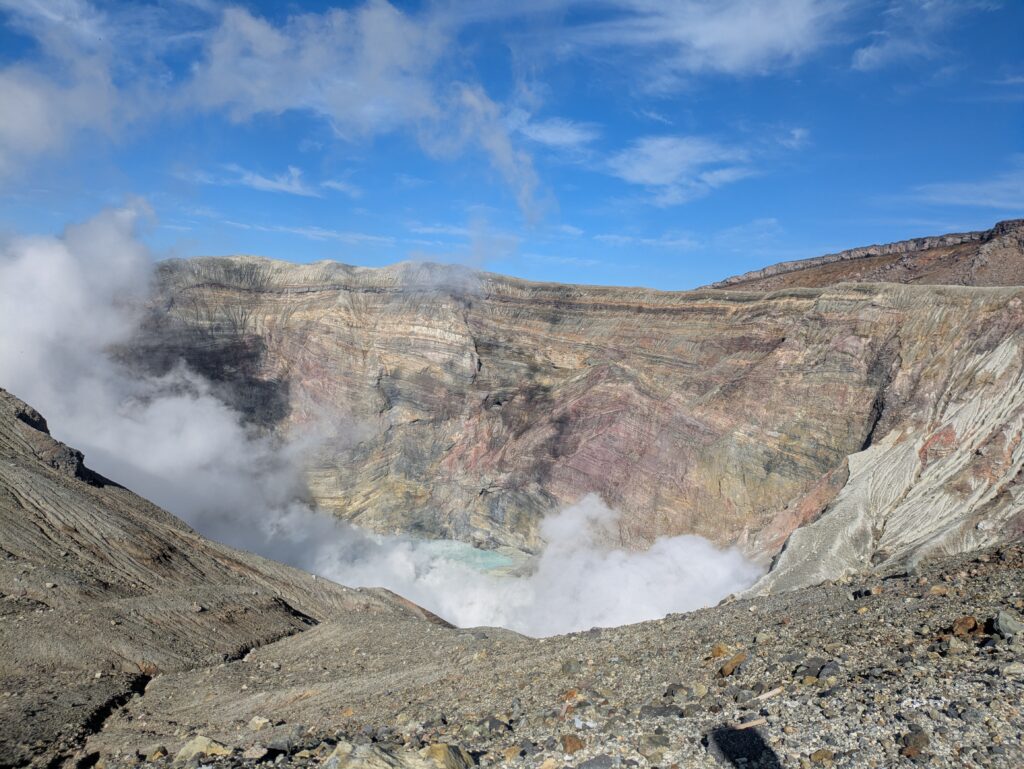
This is the main event and the source of the massive plume of white steam you can see billowing into the sky from the plateau. It is a highly active, deeply dramatic chasm. Under normal circumstances when safety zones are open, a path leads right to the edge where concrete emergency bunkers line the rim, allowing visitors to peer down into a brilliant, milky-turquoise acid pool. For now, you will have to admire its power from the safety of the plains below.
Komeduka (The Legend of the Rice Mound)
As you drive up the mountain roads toward the plateau, keep an eye out for a small, distinct hill that looks like a perfectly shaped green inverted bowl with a slight dip in the top. This is Komeduka, a dormant, grass-covered volcanic cone.
The name literally translates to “Rice Mound.” According to local Shinto legend, the ancient pioneer god of Aso, Takeiwatatsu-no-Mikoto, created the hill by piling up a massive mound of harvested rice to secure food for the local people. The story goes that during a terrible famine, the god scooped out a handful of rice from the very top of the pile to give to a starving family. What you are looking at today is a volcanic hill, but to locals, it is a lasting symbol of the mountain’s generosity.
The Black Sands of Sunasenri-ga-hama
While the main concrete path to the crater rim is blocked off by barriers, you can still access parts of the surrounding landscape on foot. If you walk toward the trailheads near the main parking terminals, you can access sections of Sunasenri-ga-hama. This is a vast plain covered entirely in jet-black volcanic ash and gravel. Walking through this silent, dark landscape feels entirely like stepping onto the surface of another planet, offering a brilliant alternative hike while the main summit is off-limits.

Looking down into the steaming turquoise acid pool of Nakadake Crater No. 1. The stark, sci-fi landscape surrounding the active vents. The walking path leading up to the crater rim area.


Final Thoughts: Staying Flexible on the Mountain
When planning a trip to a natural wonder like Mt. Aso, it is a humbling reminder that Mother Nature is ultimately the one in charge. She decides whether the weather will play nice, and she dictates whether the volcano will behave well enough to let us near—constantly shifting the invisible gas levels that can close the paths at a moment’s notice.
But as we have seen recently, human elements play a major part, too. The helicopter crash inside the crater rim and the devastating loss of life is a tragedy. The ongoing closure of the summit out of respect and necessity for investigation is entirely understandable, and as travelers, our job is to respect those boundaries without complaint.
With any travel plans—whether they are focused on nature or man-made attractions—you simply have to be flexible. Sometimes, when things don’t work out the way you originally planned, you end up finding yourself walking along a path less traveled, or seeing something incredible that you totally didn’t expect.
Exploring an active volcanic caldera means stepping into a living, changing landscape. Even when the gates to the very top are locked, the vast beauty of the Aso region remains completely open to those willing to slow down and look around. Adjust your expectations, give yourself time to explore the winding mountain roads, and enjoy the incredible vistas from the plateau—because even from a distance, Mt. Aso is unforgettable.